The recent publication of an excavation report (reference 1) reawakened my interest in the early history of this glasshouse. It appears to be unique, in that it was associated at different times with all common forms of glass making: mirror, vessel, bottle, window (crown) and plate glass.
The Bear Garden glasshouse stood in Bear Alley on the Bankside (reference 2). John Bowles and William Lillington probably owned the Bear Garden glasshouse in 1678. Then they were described as ‘Masters of another glasshouse … for making white and green glasses in Southwark’; white then meant clear glasses. William Lillington had taken a lease from John Squibb on 1 August 1671 on property at the Bear Garden, then said to include a pothouse and a glasshouse. It is thus possible that it was one of the 'two new furnaces opened for very fine large crystal' referred to by Alberti, the Venetian secretary in London, in September 1673 (reference 3). By 1684 it was probably owned by Bowles alone, when an agreement described him as: “Master of several glasshouses at St Mary Overye's and the Bear Garden in Southwark for making Green glass” (reference 4). He is said to have mainly produced bottles, but by 4 June 1689, “There is now made at the Bear-Garden Glass-house on the Bank-side crown window glass much exceeding French glass in all its qualifications”. Bowles, who came from a rich Lincolnshire family, sold the glass works and transferred to another site in 1691 and in 1695 was one of the commissioners for managing the duty on glass.
The following extract from reference 5 most likely concerns the Bear Garden glasshouse. Gustav Jung had received a Swedish state scholarship for a long study trip in Europe during which he visited ‘over a hundred glasshouses’ and made notes on them.
Gustav Jung’s notebook from his study trip is in the collections of the Uppsala University Library. Of special interest are his drawings of two different furnace types. The first clearly shows a winged furnace which became common in the glass industry in England and Western Europe around the beginning of the century…. The side view drawn by Jung shows three openings in the middle part, suggesting that the furnace was for six crucibles… The furnace shown in the illustration is probably from England, where Jung travelled in 1667-1668. Notes survive concerning three sites, which Jung called the “Sudriks” mirror-glass works, the “Tur glasshouses in “Lunh” (London) and the Commoncard mirror-glass works. Mentioned as the owners of “Sudriks” were ‘Gebril Harper, Thomas Uettin, and Welem Lilieston”; the masters induded “Bastian Miato, Johannes Babtist and Robert Salsberg”. According to Jung’s diary, he also saw winged furnaces in Brittany, but he only made detailed notes of them in England. He even recorded the melting mixtures and instructions for building the furnace at “Sudriks” (UUE D1616).
Since sud means south, ‘Sudriks’ probably means Southwark and Welem Lilieston is almost certainly William Lillington. The last line suggest that Jung witnessed the Bear Garden glass furnace being built, or rebuilt, and also thought the mixtures used were noteworthy, probably because they were a new ‘crystal’ type formulation. There is no record of the mirror works being a success, so it looks like vessel glass may have been made there when Lillington took over the lease in 1671. Crystal glasses were then probably melted in wood-fired furnaces and it is possible that Bear Garden glasshouse was originally wood fired, since there are references to woodmongers and timber merchants in Western Southwark from 1664 (reference 6). However, it would almost certainly have been coal fired when used for ‘green & window glass’, which ties in with references to fines for the nuisance caused by smoke from 1689 (reference 7).
In the 1670s, drinking glasses often had a small glass disc attached to the stem, imprinted with a device on them, similar to the way that wax seals were used for documents. Fragments of a drinking glass with a bear’s head or a boar’s head seal have been excavated at Tunsgate, Guildford (reference 8). It has been suggested that this seal is linked to the Bear Garden glasshouse. This would seem reasonable, since it was probably the closest one to Guildford at that time. On stylistic grounds, this sealed glass dates from c1675 and is made from a high soda, mixed alkali, non-lead ‘crystal’ metal. This is probably the type of glass the Bear Garden glasshouse was making, since if it had been using lead in the glass, it would probably have been referred to as making ‘flint’ glass rather than ‘white’ glass in 1678. The fragments of vessel glass found on the site and illustrated in reference 1 appear to date from before about 1680.
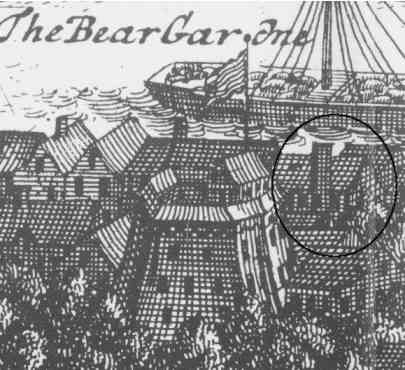
Illustration from “A Prospect and Street Plan of London by Johann Homann”. The prospect is clearly a composite, produced at a number of different times. What is interesting about this segment of it is that it lines up with archaeological evidence reported in reference 1. The ringed building is the one associated with archaeological glass-making finds and the smaller building closer to the Thames is designated building 2 (phase 2). The Bear Garden Glasshouse was probably made up of parts, or all, of buildings 13, 14, 27, 28 (phases 1 & 2) in reference 1. In particular the description (p.41) of ‘a small vaulted brick cellar, possibly for the storage of coal’ under the eastern wall of the building suggests an air duct to feed a glass furnace.
References:
1 Mackinder, A., & Blatherwick, S., Bankside - Excavations at Benbow House, Southwark, London SE , MOLAS Archaeology Studies Series 3, 2000
2 Buckley, F., Old London Glasshouses, 1915, p.26.
3 Charleston, R.J., English Glass, 1984, p.110.
4 Powell, H.J., Glass-Making in England, 1922, p.38.
5 Matiskainen, H., & Haggren, G., Finland’s oldest glass furances, Annales AIHV 13, 1995, pp. 449-451.
6 Higham, F., Southwark Story, 1955, p.206.
7 Watts, D.C., Why George Ravenscroft introduced lead oxide into crystal glass, J Glass Tech 31, 1990, pp.2-3.
8 Fryer, K., & Selley, A., Excavation of a pit at 16 Tunsgate, Guildford, Surrey, 1991, J. Post Med. Arch 31, 1997, pp 139-230.